In Brief
Ripple deployed $4 billion across four strategic acquisitions in 2024—GTreasury ($1 billion), Rail ($200 million), Palisade, and Ripple Prime—building end-to-end infrastructure for enterprise payments and digital asset services, yet XRP declined 31% over the past two months.
Regulatory approvals in Singapore (expanded Major Payment Institution license) and UAE (RLUSD stablecoin approval for institutional use) demonstrate institutional adoption progress, but these developments benefit Ripple’s business operations rather than directly creating XRP demand or utility.
XRP network velocity increased substantially according to CryptoQuant data, indicating rapid trading turnover and reduced long-term holding behavior, while Santiment sentiment analysis shows extreme fear among market participants despite positive corporate developments.
Korean exchange Upbit held 6.18 billion XRP as of December 4—the highest level of 2025—creating potential overhang risk, while rising short positions in derivatives markets reinforce near-term downside pressure independent of Ripple’s strategic progress.
The disconnect between Ripple’s enterprise expansion and XRP price performance reveals fundamental tension: Ripple’s acquisitions strengthen its position as payments infrastructure provider, but most enterprise use cases being built don’t require XRP token utilization, creating value for Ripple Labs without necessarily translating to XRP demand.
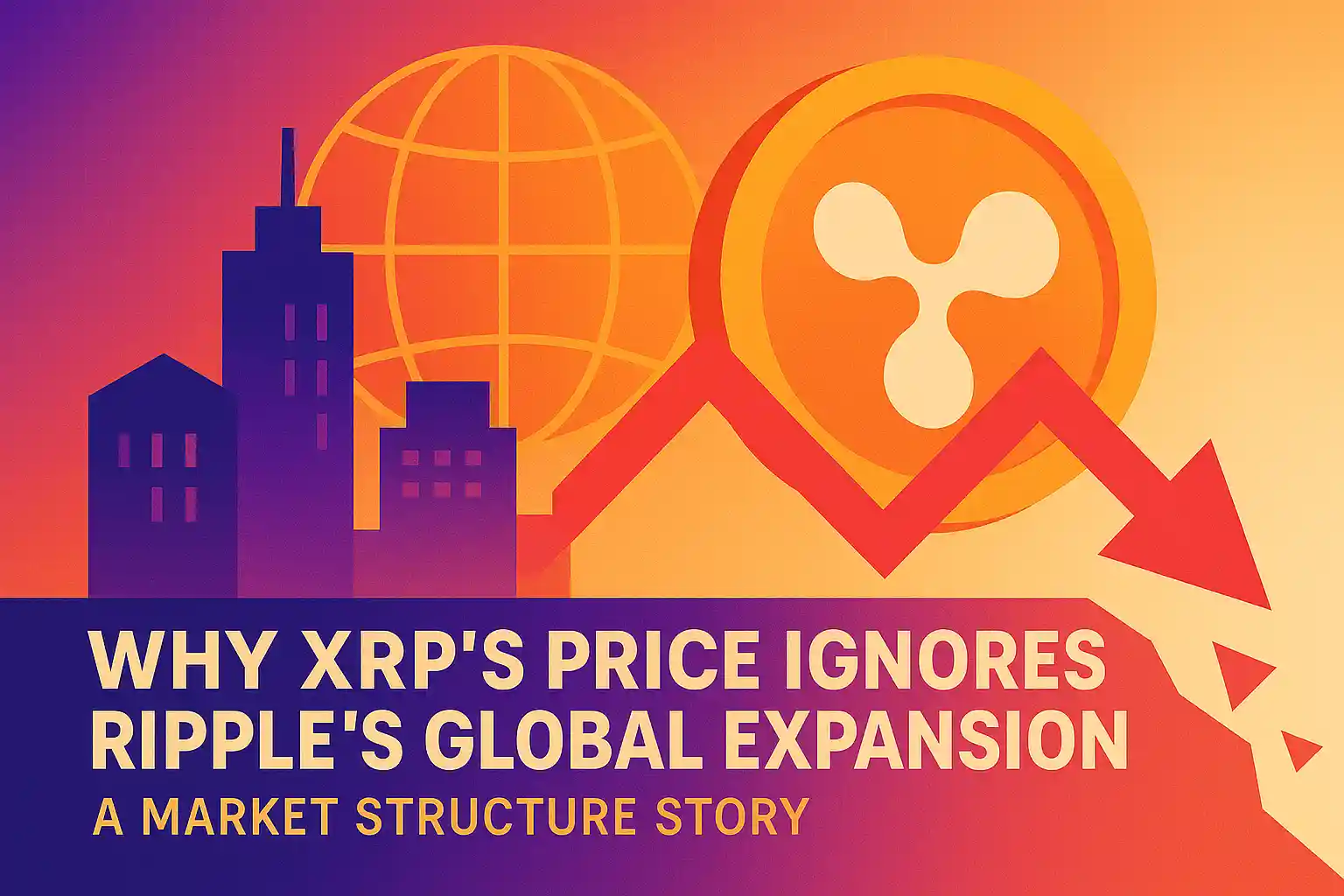
XRP has declined 31% over the past two months even as Ripple deployed approximately $4 billion across strategic acquisitions designed to create comprehensive enterprise payments and digital asset infrastructure. The stark disconnect between Ripple’s aggressive business expansion—including regulatory wins in Singapore and the UAE, major acquisition announcements, and institutional adoption progress—and XRP’s price weakness illustrates a fundamental tension in cryptocurrency markets where token price performance often decouples from underlying business development. Understanding why XRP refuses to appreciate despite what appear to be positive catalysts requires examining the specific nature of Ripple’s acquisitions and whether they actually create XRP utility, how market structure factors including exchange concentration and derivatives positioning override fundamental developments, what role sentiment and holding behavior play when institutional adoption occurs without retail participation, and whether the disconnect represents temporary inefficiency that resolves through eventual price appreciation or permanent structural reality where Ripple’s success doesn’t require XRP price increases.
Ripple’s $4 Billion Acquisition Strategy Builds Payments Infrastructure
Ripple outlined four major acquisitions on December 4 aimed at creating vertically integrated infrastructure for enterprise payments and digital asset services. The acquisitions totaling approximately $4 billion include:
GTreasury (approximately $1 billion): Corporate treasury management software that provides cash forecasting, risk management, and payments workflow automation for enterprise clients. This acquisition positions Ripple to serve CFOs and treasury departments managing complex multi-currency operations.
Rail (approximately $200 million): A stablecoin-focused payments infrastructure provider that enables businesses to integrate digital dollar payments into existing systems. Rail’s technology facilitates instant settlement and reduces friction in cross-border transactions.
Palisade: A custody and digital asset security provider offering institutional-grade storage solutions with insurance backing and regulatory compliance frameworks suitable for enterprise clients.
Ripple Prime: An institutional liquidity platform designed to provide market-making services, deep order books, and execution infrastructure for large-scale digital asset transactions.
Ripple President Monica Long framed these acquisitions as creating a unified platform:
Ripple is delivering a complete payments stack backed by enterprise-grade digital asset services that give institutions everything they need to engage in, benefit from, and scale with the on-chain economy.
The strategic logic proves straightforward: by controlling treasury management software (GTreasury), stablecoin payment rails (Rail), secure custody (Palisade), and institutional liquidity (Ripple Prime), Ripple creates a one-stop solution for enterprises seeking to integrate digital assets into payment workflows without requiring separate vendors for each function.
😨 XRP (-31% in the past 2 months), unlike Bitcoin, is seeing the most fear, uncertainty, & doubt (FUD) since October, according to our social data.
🔴 Circles indicate days where there are abnormally higher BULLISH comments compared to BEARISH comments, about XRP (Greed Zone)… https://t.co/lJNW8zlRwK pic.twitter.com/ZoFmwrtw3h
— Santiment (@santimentfeed) December 4, 2025
However, a critical question emerges: Do these acquisitions actually require XRP token utilization, or do they strengthen Ripple’s business while remaining functionally independent of XRP demand?
Regulatory Wins Demonstrate Institutional Progress Without Direct XRP Utility
Ripple secured significant regulatory approvals in Asia and the Middle East that validate its compliance approach and expand operational scope, yet these approvals primarily benefit Ripple’s stablecoin and payments infrastructure rather than creating direct XRP demand.
Singapore Approval: The Monetary Authority of Singapore granted Ripple an expanded Major Payment Institution license, allowing broader regulated payment operations across the Asia-Pacific region. Fiona Murray, VP & Managing Director for APAC, emphasized the region’s leadership in practical digital asset usage rather than speculative trading.
This approval enables Ripple to offer payment services throughout Singapore and potentially expand into other APAC markets that recognize MAS licensing. However, the approval covers Ripple’s payment services broadly—it doesn’t specifically mandate or incentivize XRP usage in those payment flows.
UAE Approval: Ripple’s RLUSD stablecoin received Financial Services Regulatory Authority (FSRA) approval for institutional use in the UAE, covering collateral, lending, and prime brokerage activities. Jack McDonald, SVP of Stablecoins, characterized this as a “signal of trust” reinforcing Ripple’s compliance and market credibility.
The RLUSD approval proves particularly significant because it validates Ripple’s ability to launch regulated stablecoin products that compete with established players like USDC and USDT. However, RLUSD—a fiat-referenced stablecoin designed to maintain 1:1 parity with the US dollar—operates entirely independently of XRP. Enterprises using RLUSD for institutional activities gain no inherent benefit from holding or transacting with XRP.
The pattern becomes clear: Ripple is building successful payments and digital asset infrastructure businesses that happen to be operated by the same company that created XRP, but the infrastructure doesn’t require XRP for most use cases being developed.
Market Structure Factors Override Fundamental Developments
While Ripple expands its enterprise business, XRP price faces several market structure headwinds that prove more immediately influential than long-term business development:
Extreme Fear Sentiment: Santiment data shows XRP investor sentiment has reached extreme fear levels despite positive corporate developments. This sentiment disconnect suggests retail participants either don’t understand or don’t value Ripple’s strategic moves, focusing instead on price action and short-term trading dynamics.
Rising Network Velocity: CryptoQuant data highlights substantially increased XRP network velocity, indicating that XRP changes hands rapidly rather than being held long-term. High velocity typically characterizes speculative trading rather than adoption for actual utility. When participants trade tokens frequently rather than holding them for functional use, it suggests the market treats XRP as a speculative vehicle rather than a payments instrument.
Korean Exchange Concentration: Upbit, the dominant South Korean cryptocurrency exchange, held 6.18 billion XRP as of December 4—the highest level of 2025. This concentration creates potential overhang risk because a single exchange controls a significant portion of circulating supply. If Upbit experiences regulatory pressure, technical issues, or if Korean retail participants decide to liquidate positions en masse, the concentrated supply creates conditions for rapid price declines.
Derivatives Short Positioning: Rising short positions in XRP derivatives markets, particularly among Korean investors, add sustained selling pressure. Short positions profit from price declines, creating direct financial incentive for participants to suppress rallies. When short interest concentrates heavily in specific markets like Korea, it creates regional dynamics that can overwhelm broader fundamental developments.
These market structure factors explain why positive business developments fail to translate into price appreciation: sentiment drives short-term trading more than enterprise adoption progress, high velocity indicates speculative rather than utilitarian holding, exchange concentration creates technical vulnerability, and derivatives positioning creates active downside pressure.
The Fundamental Disconnect: Ripple Success Doesn’t Require XRP Price Appreciation
The most critical factor explaining XRP’s price weakness despite Ripple’s expansion is that Ripple’s business success doesn’t fundamentally require XRP price appreciation for most use cases being developed.
GTreasury Integration: Corporate treasury management software optimizes cash flows, manages FX risk, and automates payment workflows. None of these functions require cryptocurrency exposure. Enterprises using GTreasury benefit from Ripple’s payments network integration, but that network can operate using traditional currencies, stablecoins (like RLUSD), or other digital assets without requiring XRP.
Rail Stablecoin Payments: Rail’s infrastructure enables businesses to integrate stablecoin payments. Stablecoins by definition maintain stable value relative to fiat currencies—they explicitly avoid the volatility characteristics that make XRP challenging for enterprise treasury management. Enterprises seeking instant settlement and reduced friction logically prefer stablecoins over volatile assets like XRP.
Palisade Custody: Institutional custody services secure digital assets regardless of which specific assets clients hold. Ripple benefits from Palisade’s custody infrastructure whether clients store Bitcoin, Ethereum, stablecoins, or XRP. The custody business doesn’t create inherent XRP demand.
Ripple Prime Liquidity: Institutional liquidity platforms serve clients seeking to trade various digital assets. While Ripple Prime presumably offers XRP liquidity, it also provides liquidity for numerous other assets. The platform’s success depends on total trading volume and institutional adoption, not specifically on XRP trading volumes.
The pattern reveals a fundamental tension: Ripple has built a successful digital payments business, but the payment flows being developed don’t require XRP for most enterprise use cases. Stablecoins offer the price stability enterprises demand. Traditional payment rails integrated with blockchain settlement offer the speed and cost benefits without cryptocurrency exposure. XRP’s original value proposition—serving as a bridge currency for cross-border payments—has been superseded by stablecoin solutions that provide similar benefits without volatility.
Analyst Perspective: Focusing on Adoption Over Price Action
Some market participants argue that XRP’s current price weakness represents temporary inefficiency that will eventually resolve as Ripple’s infrastructure expansion translates into increased adoption. Black Swan Capitalist articulated this perspective:
I stopped looking at the XRP chart a long time ago. The candles mean nothing without context. I watch who is adopting what, why they are adopting it, and which systems are being rebuilt behind the curtain.
This viewpoint emphasizes that enterprise adoption operates on longer timelines than speculative trading cycles. According to this framework, Ripple’s acquisitions create infrastructure that will eventually drive XRP utility and demand, but the market hasn’t recognized this value yet because enterprise integration occurs gradually and quietly compared to retail speculation.
The counterargument proves equally compelling: perhaps the market correctly prices XRP based on realistic assessment that Ripple’s infrastructure expansion creates value for Ripple Labs shareholders without creating corresponding XRP utility. If enterprises can achieve all the benefits Ripple promises—instant settlement, reduced costs, regulatory compliance, enterprise-grade security—using RLUSD stablecoins rather than XRP, then Ripple’s success actually validates a business model where XRP remains peripheral rather than central.
Forward Outlook: What Would Actually Drive XRP Demand?
For XRP price to appreciate sustainably rather than experiencing temporary speculative rallies, specific developments would need to create actual token demand rather than general ecosystem positivity:
Mandatory XRP Utilization in Ripple Products: If Ripple implemented requirements that enterprises must hold or transact with XRP to access GTreasury features, Rail payment rails, or institutional liquidity services, it would create genuine demand. However, this seems strategically unlikely because enterprises resist cryptocurrency exposure for treasury management.
XRP-Specific Fee Discounts or Benefits: If Ripple offered meaningful discounts or enhanced functionality to clients using XRP rather than stablecoins, it could incentivize adoption. This would need to be substantial enough to overcome enterprises’ preference for price stability.
Regulatory Clarity Enabling XRP ETF Inflows: The article mentions XRP ETFs and potential Vanguard inflows. If major asset managers launch XRP ETF products that attract institutional capital flows similar to Bitcoin ETF success, it could create sustained buying pressure independent of utility considerations. However, ETF approval remains uncertain, and even approved ETFs don’t guarantee sustained inflows.
Bridge Currency Adoption at Scale: If Ripple successfully positioned XRP as the dominant bridge currency for cross-border payments—the original vision—it would create sustained demand. However, stablecoins have largely captured this use case without XRP’s volatility drawbacks.
Reduced Korean Exchange Concentration: If the 6.18 billion XRP concentrated on Upbit distributed more evenly across global exchanges, it would reduce technical overhang risk and potentially stabilize price action. However, this requires either Korean regulatory changes or Korean retail participants voluntarily redistributing holdings.
Without these specific catalysts creating actual XRP demand, Ripple’s continued business success may simply reinforce the disconnect: Ripple Labs thrives as a payments infrastructure company while XRP remains a speculative asset whose price depends more on trading dynamics than fundamental utility.
Near-Term Price Risk: Technical Levels and Sentiment
From a trading perspective, XRP faces clear near-term downside risk regardless of long-term fundamental debates. As of writing, XRP traded at $2.09, down nearly 4% in 24 hours. Analysts warn that continued selling pressure could drive retests of $1.90-$2.00 support levels established during recent lows.
The technical risk emerges from several converging factors: extreme fear sentiment creates psychological pressure for holders to capitulate, rising network velocity indicates speculative turnover rather than conviction holding, Korean exchange concentration creates potential for cascading liquidations if regional selling accelerates, derivatives short positioning creates active downside pressure that profits from declines, and absence of clear positive catalysts leaves the asset vulnerable to broader market weakness.
The bullish counter-narrative emphasizes that early December gains aligned with broader cryptocurrency market recovery, suggesting XRP can participate in sector-wide rallies even if fundamental catalysts remain absent. However, this represents correlation with Bitcoin and major assets rather than XRP-specific strength.
Conclusion: Token-Business Value Separation Reveals Cryptocurrency Market Maturation
The disconnect between Ripple’s $4 billion infrastructure expansion and XRP’s 31% decline over two months reveals a maturing dynamic in cryptocurrency markets: tokens created by companies don’t automatically appreciate when those companies succeed if the business model doesn’t require token utilization.
Ripple is building a genuinely valuable payments and digital asset infrastructure business. The acquisitions are strategically coherent. The regulatory approvals validate compliance. The enterprise adoption is real. However, nearly all of this value creation occurs using stablecoins, traditional payment rails enhanced with blockchain settlement, and custody services that work for any digital asset—not specifically XRP.
For XRP holders, this creates an uncomfortable reality: they own a speculative asset whose price depends primarily on trading dynamics, sentiment cycles, and potential future utility that may never materialize, while the company that created XRP builds a successful business that largely bypasses XRP utilization.
The 2026 roadmap mentions further integration of acquired assets and expanded corporate treasury services. Unless that integration specifically mandates or strongly incentivizes XRP usage rather than stablecoin alternatives, Ripple’s continued success may simply widen the disconnect between business fundamentals and token price.
Market participants must decide whether they believe this disconnect represents temporary inefficiency—where the market hasn’t yet recognized XRP’s value—or permanent structural reality where Ripple’s success actually validates a future where enterprise payments use stablecoins rather than volatile cryptocurrencies like XRP.
Missed buying crypto at the market bottom?
No worries, there's a chance to win in crypto casinos! Practice for free and win cryptocurrency in recommended casinos! Our website wheretospin.com offers not only the best casino reviews but also the opportunity to win big amounts in exciting games.
Join now and start your journey to financial freedom with WhereToSpin!
Middle East
wheretospininkuwait.com provides a comprehensive selection of trusted online casino reviews for the Middle East أفضل كازينو على الإنترنت. The platform features well-established casinos supporting crypto deposits in the region, including Dream Bet, Haz Casino, Emirbet, YYY Casino, and Casinia.
South Africa and New Zealand
In the South African online casino market, wheretospin.co.za highlights top-rated platforms and online casinos such as True Fortune Casino and DuckyLuck. Meanwhile, for New Zealand players, wheretospin.nz showcases highly recommended casinos, including Casinia, Rooster.bet, and Joo Casino.